
The best places to find remote jobs in Africa are the ones that tell you, on every listing, who the employer will actually hire. Use The Tech Hut if you live in Kenya and want a vetted list. Use Remote4Africa for the widest mix of categories and entry-level roles. Use RemoteAfrica for a small board of Africa-only roles with dates. Use Working Nomads for tech and contract work. Use LinkedIn or Indeed when you want NGO roles or only the newest postings.
The problem is not a shortage of listings. It is that most remote jobs do not hire in Africa. A post tagged "remote" can mean US residents only, South Africa only, or a time-zone window that rules you out. You can lose a weekend applying to roles that were never open to you.
This article orders five sources by how well they filter that out. For each one you get what it offers, who it suits, and the catch. Along the way you will see how to handle entry-level, no-experience, freelance and NGO searches, and how to see only what was posted in the last three days. We run The Tech Hut, so it comes first, and we say plainly where it does not fit.
1. The Tech Hut, for remote jobs open to Kenyans
The Tech Hut is the right first stop if you live in Kenya, because it separates remote roles that hire from Kenya from roles that only say "remote". That separation matters more than the number of listings.
What you get
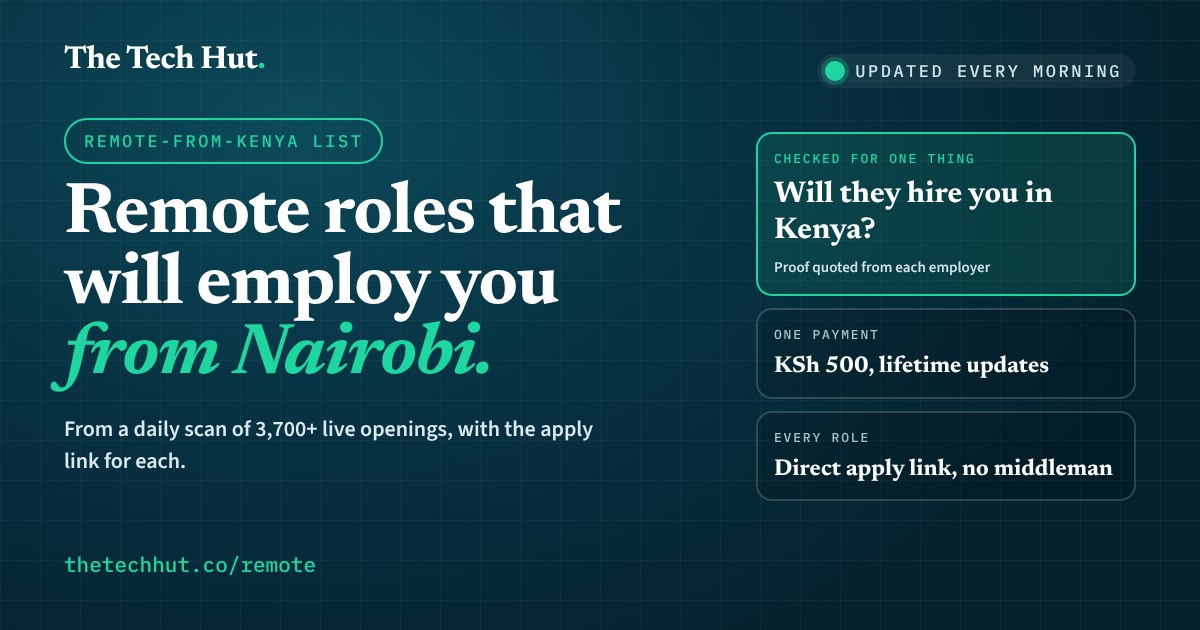
The paid centrepiece is The Remote-From-Kenya List, built from a daily scan of more than 3,700 live openings. It keeps only companies that will employ someone based in Nairobi, shows the wording that proves it, and links straight to the application. On 15 November 2026 that scan found 483 such roles at 51 companies. It is updated every morning and costs KSh 500 at the launch price (regular price KSh 1,000), paid once by M-Pesa or card, with lifetime updates. For remote jobs across Africa, the free tools around it help too:
- Jobs board: live roles read from employers' own hiring systems, filterable by Kenya, the rest of Africa or remote.
- Daily job alert: a free morning email of new openings.
- WhatsApp channel: jobs, news and events for over 9,000 followers.
- Early Access: from KSh 250 a month, with every role 24 hours before the public channel.
Who it suits and the catch
It suits Kenyan graduates, career changers and developers who are tired of roles that exclude Kenyan applicants. If recruiter software keeps rejecting your CV, the CV Blueprint (KSh 250) and the ATS Pass (KSh 1,000 launch price) address that directly.
The catch is focus. The paid list is built for people based in Kenya, so a job seeker in Nigeria or Ghana gets more from the free board's rest-of-Africa filter. The board also skips employers whose hiring systems it cannot read automatically.
A remote job only counts if the employer will hire from where you live.
2. Remote4Africa, for categories and entry-level roles
Remote4Africa is the best starting point for entry-level and no-experience searches, because it sorts roles into clear categories and has a dedicated entry-level page.
What you get
The site says it lists 1,400+ jobs a month from 1,000+ companies. Categories run from customer support and virtual assistant work to sales, admin, finance and data science. Each listing carries a location label, such as "Anywhere in the World" or a named city. That label is how you filter for roles open across Africa. Some listings show pay, for example US$7 to US$8 an hour for a gaming marketplace support role.
A free account gets job alerts twice a week. Paid members get them daily, plus access to members-only roles, from US$1.46 a month on the yearly plan. Free tools include a resume builder and interview practice.
Who it suits and the catch
It suits first-time remote workers. Customer support, virtual assistant and sales roles are the usual way in when you have no experience, and the entry-level page collects them. Admin, education and media categories also turn up NGO-style work.
The catch is the paywall. On the page we reviewed, 13 of 20 jobs were for members only, and some company names were hidden. A free account shows you only part of the picture. Read the location label before you apply, because "Anywhere in the World" and "Cape Town" are very different promises.
Start with the entry-level page, but read the location label before the job title.
3. RemoteAfrica, for Africa-only listings
RemoteAfrica is a small board where the location rule is part of every listing, so you waste less time on roles that exclude you. That makes it a good filter for remote jobs in Africa.
What you get
Each card shows the employer, the posting date, the location rule, the contract type and a category. Rules read "Africa only" or name a single country such as Nigeria or South Africa. Types include full-time, part-time and contract. Categories include customer support, marketing, engineering and devops.
The board holds a few dozen listings at a time. Some entries are marked "1yr+ ago", so ignore anything posted in 2025 or earlier. A few roles sit behind a US$20 a month unlock, and sponsored slots are clearly labelled.
Who it suits and the catch
It suits people who want contract, part-time or freelance work and do not want to guess about eligibility. Dates also make it easy to scan for roles from the last three days. Check it every few days and apply while a post is fresh.
The catch is size, and some posts are weak. You will see offers titled "no experience" or "copy and paste, simple work". Treat those with care. Research the employer, never pay to apply, and be wary of vague pay. "Africa only" can also still mean one country, so read the full post.
The newest posting with a clear eligibility line beats ten old ones with none.
4. Working Nomads, for tech and contract roles
Working Nomads suits people with technical or professional skills, because its Africa page is large, sortable by date, and tagged by seniority and contract type.

What you get
The Africa page lists several hundred roles. Each is tagged by category, such as development, sales, finance or marketing, plus a seniority level from entry to senior and a job type such as full-time or contract. Switch the sort to date to see the latest first. Repeat posters include Canonical, Kraken and Proxify, so you see the same employers' roles across countries. A premium plan unlocks hidden jobs.
Who it suits and the catch
Developers, data people, product managers and finance staff get the most from it. Freelancers should filter for contract roles, which Proxify-style postings use heavily. A few entry-level tags exist too, for example gaming support agent roles.
The catch is the location field. Tags like "EMEA" or "CET +/- 3 hours" are not the same as "Africa". Several roles name specific countries such as Egypt, Tunisia, Algeria or South Africa. For Kenya, check that the employer accepts your country and your time zone before spending time on an application. Many posts are senior, so beginners will find fewer matches here.
A broad region tag like EMEA is a question to answer, not a green light.
5. LinkedIn and Indeed, for NGO roles and fresh postings
LinkedIn and Indeed work best when you want volume, NGO roles or only postings from the last three days, as long as you set the filters yourself.

What you get
Both sites let you filter by remote work and by date posted. Set the shortest window for remote jobs in Africa posted in the last 3 days, and check daily. Indeed offers a three-day window. LinkedIn's shortest windows are 24 hours and a week. For NGO work, add words such as "NGO", "programme" or "development" alongside "remote". Follow this routine:
- Set your location to your own country, then add the remote filter.
- Choose the shortest date window.
- Read the eligibility line in the full description.
- Apply within a day, while the post is new.
Search for "Remote Africa" alone and you will often get roles that are remote for US residents only. Glassdoor and ZipRecruiter behave the same way.
Who it suits and the catch
These sites suit experienced applicants, NGO and development job seekers, and freelancers who use the contract filter. NGO roles are often posted on the organisation's own careers page too, so check both. Our guide to NGO remote jobs in Kenya lists the NGO job boards worth bookmarking.
The catch is noise. Volume brings scams and listings that exclude Africa entirely. A real employer will not ask you for money, so treat any request for a fee as a reason to stop.
On the big boards, your filters do the work the site does not.
Where to start your search
Pick the source that matches your situation. If you live in Kenya, begin with The Tech Hut. Use Remote4Africa when you have little experience. Use RemoteAfrica for dated, Africa-only roles. Choose Working Nomads for tech and contract work. Use LinkedIn and Indeed for NGO roles and the last three days of postings. Across all five, the habit that pays off is the same: read who the employer will hire before you read the job title.
Check your sources daily, apply early, and keep your CV clean for recruiter software. If you want the filtering done for you, see the Remote-From-Kenya list. For a wider comparison of remote job sites, read 8 places to find legit remote jobs in Kenya.
See the Remote-From-Kenya list
Listing counts, prices and features for other sites are as shown on those sites in November 2026 and change often. Role counts for The Tech Hut are from our scan of employers' hiring systems on 15 November 2026. Photos: Unsplash.